Cardiac Monitoring · Patch Comparison
The patch that doesn't come back.
Many monitoring companies use patches that record on the device and have to be mailed back before anyone can read them. Ours transmits as it records, and is simply thrown away at the end of the study. Here's what that changes for your practice.
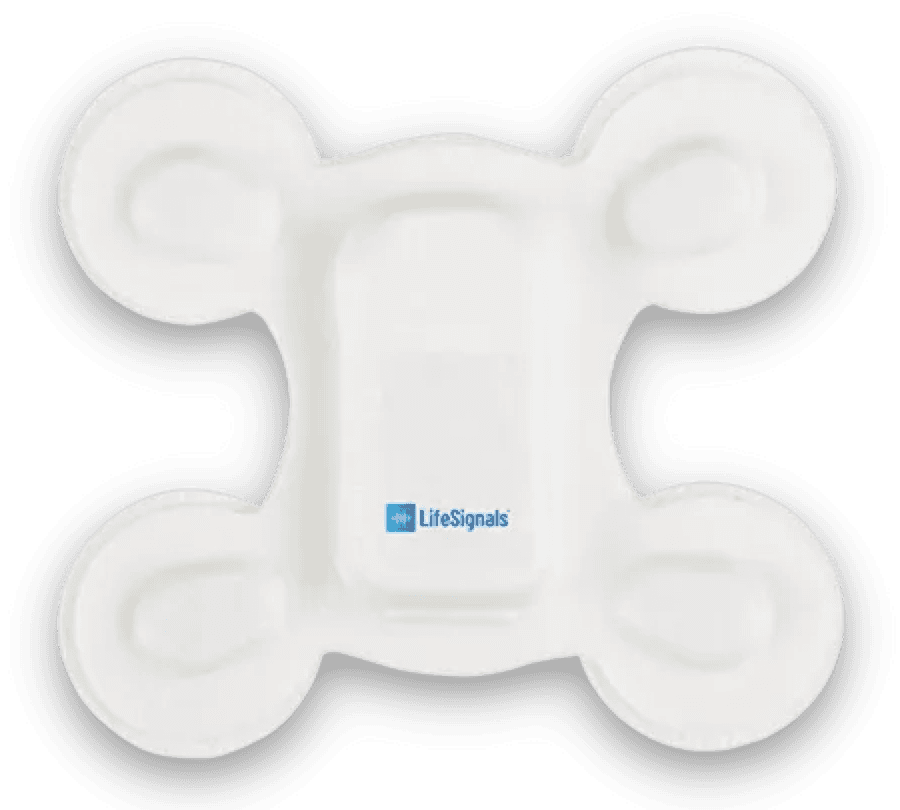
Side by side
Our patch vs. a mail-back patch.
LifeSignals patch
Typical mail-back patch
- When you see the data
- OursDuring the study — ECG is transmitted as it is recorded
- Mail-backAfter the patch is mailed back and processed
- Significant arrhythmias
- OursNotified while the study runs, per your protocol
- Mail-backTypically found once the recording is analyzed
- End of the study
- OursPatient removes the patch and throws it away
- Mail-backPatient packs the device and ships it back
- Risk in transit
- OursNothing in transit — no recording to lose
- Mail-backA lost or delayed package means a lost or delayed study
- Report turnaround
- OursStarts when the study ends
- Mail-backStarts when the package arrives
Built to be worn
Why patients keep it on — and practices keep using it.
- Gentle on the skin
- Very few instances of allergic reaction with our patches — so patients keep wearing them for the full study.
- Up to 30-day studies
- Each patch lasts up to 7 days. Longer studies continue seamlessly with a patch change at home — no office visit, no gap in the record.
- MCT and more, from one patch
- Mobile Cardiac Telemetry, Holter, Extended Holter, and Wireless Event from the same single-use device.
- Light and showerable
- 28 grams, no leads, IP24 water resistant. Patients sleep, exercise, and shower through the study.
The efficiency case
More monitoring days from the same footprint.
A mail-back patch only earns its keep while it is on a patient. The rest of the month it is in the post, being processed, and waiting to be restocked before the next study can start.
A single-use patch supplied on a licence has no return loop. One study ends, the next starts on a fresh patch, and capacity is set by the licence rather than by how fast devices come back.
Our patch
26–27
active monitoring days per device, per month
Mail-back patch
15–16
active monitoring days per device, per month
About 50% higher device utilization — the same footprint covering roughly half again as many patient days.
ROI comparison
What the extra days are worth to your practice
Our patch
18.9
studies / month
Mail-back patch
11.1
studies / month
Difference
+7.9
more studies / month
Illustrative only. Assumes 26.5 active monitoring days per device per month on a single-use patch versus 15.5 for a patch that has to be mailed back, processed, and restocked. Actual results depend on your patient volume, study mix, and payer contracts.
Run the numbers with us.
A short call — no obligation. We'll model the switch against your actual study volume and current monitoring setup.